
BLACK+DECKER BDEMS600 vs SKIL SR232301: Which Fits Your Detail Work?
Choose the BDEMS600 for a pad-and-finger setup when your jobs stop at corners and narrow details. Choose the SR232301 when its supplied louvre and flexible attachments match recurring work, and keep suitable sheets for each shape. The BLACK+DECKER procedure below is specifically for Type 2; check the delivered tool’s type.
Published by Pickoryx · Published 2026-10-10
Source checked 2026-10-10 17:22 UTC
Products compared

Product A · ASIN B00OJWLNMO
BLACK+DECKER BDEMS600
Last observed offer
$50.51 List Price: $64.00
Per listed package.
Offer eligibility must be confirmed on Amazon.
Checked 2026-10-19 13:23 UTC. Price and availability may change.
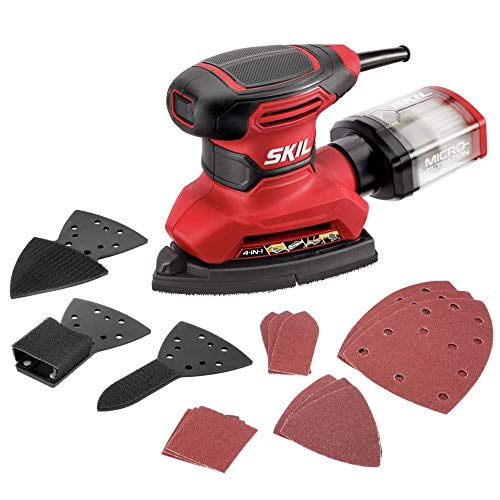
Product B · ASIN B07FDL1TW5
SKIL SR232301
Last observed offer
$44.00
Per listed package.
Offer eligibility must be confirmed on Amazon.
Checked 2026-10-19 07:15 UTC. Price and availability may change.
Pickoryx may earn a commission from qualifying purchases through the paid Amazon links on this page, at no added cost to you.
The buying question
Which attachment setup fits corners, louvers and curves, and what sheet and dust-box care comes with it?
A pad-and-finger setup for a limited detail brief versus SKIL’s additional louvre and flexible shapes, with matching abrasive and filter-care tasks.
Quick verdict
Choose BLACK+DECKER BDEMS600 if
- A corner/detail pad and finger accessory cover your planned work.
- Its current offer is preferable and you do not need the SKIL attachment set.
Choose SKIL SR232301 if
- Louvers or rounded edges are part of the job.
- You want the documented tool-free attachment changes.
When the recommendation changes
- The job needs a particular curve or louvre attachment.
- The delivered BLACK+DECKER type has a different procedure; match its label and manual before use.
The differences that matter
Attachment Change Workflow
What this changes: Choose by the surfaces on the job: the BLACK+DECKER pad-and-finger arrangement covers a basic corner/detail brief; SKIL adds a useful louvre/curve kit when those shapes recur. Verify the BLACK+DECKER type before relying on its change procedure.[1, 3, 2, 4]
Sheet Filter Care
BLACK+DECKER BDEMS600
Type 2: align sheet holes and use the proper finger sheet. Empty the canister every 10 minutes: pull it off, separate its halves at the tab, gently shake/tap, reassemble and push it firmly back.[3]
SKIL SR232301
Use corresponding hook-and-loop sheets, clear backing-pad dust and align holes. Empty frequently, after sanding and before storage. Knock or soft-brush dust out of the microfilter; do not wash it with soap and water.[4]
What this changes: Attachment choice also commits you to matching abrasives. Plan canister-emptying breaks with either tool; SKIL’s filter is a dry-cleaning task, not a rinse-and-reuse filter.[3, 4]
Best for your routine
Corners and occasional narrow details
The better fit depends on your priorities
Both offer a finger accessory. Choose on the actual offer and the matching tool’s change routine when extra shapes will go unused.
Repeated changes between louvers and curved details
Best fit: SKIL SR232301
Based on listed features, not comparative testing.
SKIL supplies the relevant extra shapes and uses tool-free changes; the flexible attachment is for some curves, not every contour.
Value and trade-offs
One or both observed offers have eligibility conditions, so no unrestricted price difference is shown.
If SKIL costs more, pay for attachment shapes you will actually use. A higher BDEMS600 price is not justified here by proven finish or dust-capture superiority.
There is not enough verified price history here for a buy-now or wait recommendation.
Limitations
- The BDEMS600 offer does not establish Type 1 or Type 2. All BLACK+DECKER manual procedures here are Type 2 instructions; verify the tool label and matching manual.
- No head-to-head testing establishes finish quality, dust capture, removal rate, vibration, safety or durability superiority.
- These are attachment-fit and care comparisons, not a complete operating or hazardous-paint-removal guide.
Questions shoppers ask
What should I check before buying replacement sheets?
Match the actual pad or attachment shape and its dust holes, rather than assuming every detail-sander sheet fits. SKIL prohibits oversized paper. Cross-brand sheet interchangeability is not established.
What changes when I sand old coatings or metal?
Coating dust can ignite: follow the coating and tool instructions and empty collected dust frequently. BDEMS600 Type 2 requires its canister for wood, but prohibits the canister or vacuum when sanding metal, and prohibits magnesium. Neither tool is for wet sanding. Read the material precautions before beginning.
Methodology and sources
Compared attachment geometry and change steps, abrasive fit, canister care and material precautions. BLACK+DECKER manual instructions remain Type 2-specific.
Research assistance organized model-specific instructions and checked source references.
View 4 sources
- 1.BDEMS600 1.2 Amp Electric Detail SanderBLACK+DECKER · Official specifications · Source checked 2026-10-10 17:22 UTC
Evidence used on this page
- Details & Features; model heading: Exact-model detail pad, finger accessory and dust canister. No speed or measured-performance claims adopted.
- 2.SR232301 1.2 Amp Multi-SanderSKIL · Official specifications · Source checked 2026-10-10 17:22 UTC
Evidence used on this page
- Configuration; What's included; Features: Finger, louvre and flexible attachments, twelve sanding sheets and tool-free changes.
- 3.BDEMS600 Type 2 instruction manualBLACK+DECKER · Official specifications · Source checked 2026-10-10 17:22 UTC
Evidence used on this page
- Printed pp. 5–6 (PDF pp. 7–8), Figs. D–F: Type 2 screw-change procedure, sheet-hole alignment, canister emptying and material/fire restrictions. Delivered type is not established.
- 4.SR232301 Multi-Function Detail Sander Owner’s ManualSKIL · Official specifications · Source checked 2026-10-10 17:22 UTC
Evidence used on this page
- Printed pp. 5, 11–13, 15–16; Figs. 2–5, 7, 11: Pad-release button, corresponding sheets, dry microfilter cleaning, dust disposal and application limits.