
Bose TV Speaker (2nd Gen) vs Bose Smart Soundbar: Which Setup Fits Your TV?
Choose TV Speaker (2nd Gen) if your TV has analog RCA or a headphone output and you want its documented direct cable hookup without a converter; that cable is sold separately. Smart Soundbar is also an option for a TV with no ARC/eARC or optical, but Bose says to add a converter and separate cable matched to the TV's output. Smart Soundbar also adds Bose-documented Atmos over HDMI eARC, network streaming, voice routines, and wireless Bose-system expansion; the TV Speaker's Atmos status remains unspecified.
Published by Pickoryx · Published 2026-10-02
Source checked 2026-10-02 19:16 UTC
Products compared
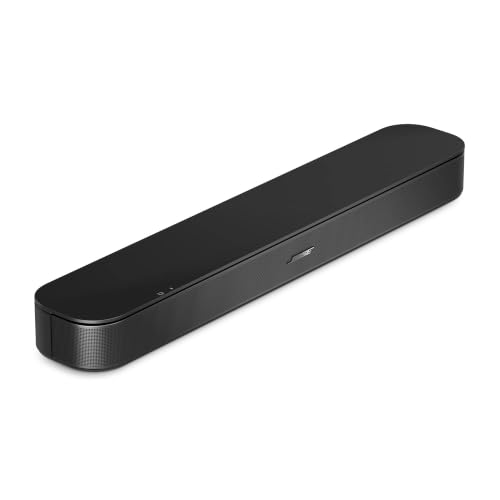
Product A · ASIN B0H8D3QLLJ
Bose TV Speaker (2nd Gen), black (901067-1100)
Last observed offer
$199.00 List Price: $299.00
Per listed package.
Offer eligibility must be confirmed on Amazon.
Checked 2026-10-19 16:57 UTC. Price and availability may change.

Product B · ASIN B0D6W8XQ6J
Bose Smart Soundbar, black (892079-1100)
Last observed offer
$549.00
Per listed package.
Offer eligibility must be confirmed on Amazon.
Checked 2026-10-19 19:09 UTC. Price and availability may change.
Pickoryx may earn a commission from qualifying purchases through the paid Amazon links on this page, at no added cost to you.
The buying question
Does your TV's available output favor a direct connection to the TV Speaker, or are you willing to add a converter for Smart Soundbar—and do you want the Smart model's documented Atmos and network features?
For TVs without HDMI ARC/eARC, the TV Speaker guide lists direct optical, analog RCA, or headphone-cable hookups. Smart Soundbar can also connect when the TV lacks ARC/eARC and optical, but Bose calls for a separate converter and cable matched to the TV's output. Smart Soundbar additionally documents Atmos over HDMI eARC, Wi-Fi streaming, voice routines, and wireless Bose-system expansion; the TV Speaker's Atmos status is unspecified.
Quick verdict
Choose Bose TV Speaker (2nd Gen), black (901067-1100) if
- Your TV has analog RCA or a headphone output, and you prefer a direct cable connection over adding a converter; Bose says the needed cable is not included.
- You prefer the TV Speaker's documented wired connection for optional bass accessories and do not need Smart Soundbar's network or voice routines.
Choose Bose Smart Soundbar, black (892079-1100) if
- You require a Bose-documented Dolby Atmos path over HDMI eARC.
- You want Wi-Fi music services, voice routines, or wireless Bose-system grouping/expansion—or you are willing to add a converter matched to your TV's output if it lacks ARC/eARC and optical.
When the recommendation changes
- If your TV has analog RCA or a headphone output but no ARC/eARC or optical, the TV Speaker guide shows direct cable hookups. Smart Soundbar is also possible with a separately purchased converter and cable; choose them to match the TV's output ports.
- If Atmos decoding is required, Bose documents it for Smart Soundbar over HDMI eARC; the cited TV Speaker materials leave Atmos unspecified, not disproven.
- If you do not plan to use Wi-Fi streaming, voice routines, or Bose wireless grouping/expansion, those Smart Soundbar features may matter less.
The differences that matter
Tv Input And Audio Format Path
Bose TV Speaker (2nd Gen), black (901067-1100)
Bose documents HDMI to a TV HDMI ARC/eARC port as the standard connection. If a TV lacks ARC/eARC, the TV Speaker guide also shows direct optical, analog RCA, or headphone-port cable alternatives; those alternate cables are not included. The cited TV Speaker materials do not specify Dolby Atmos decoding, so Atmos support remains unconfirmed here.[1, 2, 3]
Bose Smart Soundbar, black (892079-1100)
Bose documents HDMI ARC/eARC or optical TV connections for Smart Soundbar. Its owner guide also says that when a TV has none of those ports, the soundbar can connect through an audio converter and separate cable (not provided); the converter and cable depend on the TV's audio output. Bose's September 2024 announcement identifies Dolby Atmos decoding and the HDMI eARC path for Atmos content, plus TrueSpace processing for non-Atmos stereo or 5.1 signals.[4, 6, 5, 7]
What this changes: For an analog RCA- or headphone-output TV, choose the TV Speaker if you want Bose's documented direct hookup without adding a converter; its required cable is still separate. Smart Soundbar remains possible with a separately purchased converter and cable matched to the TV's output ports. If Atmos decoding is required, Bose documents it for Smart Soundbar over HDMI eARC while the TV Speaker's status remains unspecified, not disproven.[2, 3, 6, 5, 7]
Streaming Control And Expansion
Bose TV Speaker (2nd Gen), black (901067-1100)
Bose says TV Speaker (2nd Gen) does not support voice assistants. Its guide lists optional Bass Module 500, Bass Module 700, and Lifestyle Ultra Subwoofer connections using a separately supplied 3.5 mm audio cable.[1, 2]
Bose Smart Soundbar, black (892079-1100)
Smart Soundbar supports Bose app and Wi-Fi setup, music streaming through supported network services, Alexa/Voice4Video voice routines, and Bose SimpleSync or multi-room grouping. Bose also lists optional bass and surround accessories, with wireless setup documented in its product materials.[4, 5, 7]
What this changes: Choose according to the functions you plan to use: Smart Soundbar documents network services, voice routines, and wireless Bose grouping/expansion. The TV Speaker guide lists optional bass accessories connected by a separate cable. These different streaming and accessory setup routines do not establish a sound-quality winner or a comparative accessory-count limit.[1, 2, 4, 5, 7]
Best for your routine
Connecting a TV with analog RCA or headphone output without adding an audio converter
Best fit: Bose TV Speaker (2nd Gen), black (901067-1100)
Based on listed features, not comparative testing.
The TV Speaker guide shows direct connections from red/white analog output using a separate 3.5 mm-to-RCA cable, or from a headphone port using a separate 3.5 mm cable. Smart Soundbar is also possible: Bose documents an external converter and separate cable when the TV lacks ARC/eARC and optical, with the needed type depending on the TV's output.
Watching Atmos-encoded TV content through a documented eARC path
Best fit: Bose Smart Soundbar, black (892079-1100)
Based on listed features, not comparative testing.
Bose documents Dolby Atmos decoding for Smart Soundbar and identifies HDMI eARC as the path to access Atmos content. TV Speaker (2nd Gen) Atmos support is unspecified in the cited sources, so this is a documented-capability recommendation, not proof that the other model lacks Atmos.
Using integrated network streaming, voice routines, or Bose wireless expansion
Best fit: Bose Smart Soundbar, black (892079-1100)
Based on listed features, not comparative testing.
Bose documents Wi-Fi services, voice features, grouping, and optional wireless accessories for Smart Soundbar. TV Speaker does not support voice assistants; its guide lists optional bass accessories connected by a separate 3.5 mm cable. No sound-quality or accessory-count comparison is inferred.
Value and trade-offs
One or both observed offers have eligibility conditions, so no unrestricted price difference is shown.
This comparison does not compare current offers. Weigh the price shown at checkout against the connection, streaming, and expansion features you expect to use.
Price history was not compared, so whether this is a good time to buy is unknown. Compare the checkout total and seller terms before purchasing.
Limitations
- No hands-on listening, setup, or performance testing was performed; this comparison uses Bose documentation.
- Bose’s current TV Speaker (2nd Gen) product page and owner guide document its connections and controls but do not specify Dolby Atmos decoding. Its Atmos support therefore remains unconfirmed here.
- For Smart Soundbar TVs without HDMI eARC, HDMI ARC, or optical, Bose documents a separate audio converter and cable chosen for the TV’s available audio outputs. Confirm the TV’s output and converter inputs before buying; Bose’s guide does not identify one converter for every TV.
- Atmos results depend on compatible Atmos content, a TV that supports the required audio path, and HDMI eARC as described by Bose; no room-based surround effect was measured.
- Optional bass modules or surround accessories are separate purchases; the two systems document different wired or wireless setup routines.
- Current prices and offer terms were not compared.
Questions shoppers ask
Does the Bose TV Speaker (2nd Gen) support Dolby Atmos?
Bose’s TV Speaker (2nd Gen) product page and owner guide describe its TV connections and listening modes but do not specify Atmos decoding. Bose explicitly documents Atmos decoding for the Smart Soundbar and says to use HDMI eARC for Atmos content. This comparison cannot promise Atmos support for the TV Speaker (2nd Gen).
Can both soundbars connect to a TV with analog or headphone output but no HDMI ARC?
Bose documents a direct analog RCA or headphone-cable hookup for TV Speaker (2nd Gen); the required cable is not included. For Smart Soundbar, Bose says to use a separate audio converter and cable when the TV lacks HDMI eARC, HDMI ARC, and optical. The converter and cable depend on the TV’s audio outputs, so check those ports before buying.
Can either soundbar add a bass module later?
The TV Speaker (2nd Gen) guide lists Bass Module 500, Bass Module 700, and Lifestyle Ultra Subwoofer connections using a separate 3.5 mm cable. Bose lists optional bass and surround accessories for Smart Soundbar and documents wireless setup. The cited materials do not establish a shared accessory-count or pairing rule, so check Bose's current compatibility guidance for the exact accessory you plan to add.
Methodology and sources
Compared Bose’s exact TV Speaker (2nd Gen) product page and owner guide with Bose Smart Soundbar product information, support setup guidance, the Smart Soundbar owner guide, and its September 2024 U.S. announcement. Connection routes, converter requirements, Atmos documentation, streaming controls, and compatible accessory routines were checked. No sound-quality or listening-performance claim was tested.
AI assistance organized source-backed facts and drafted this comparison. No hands-on product testing was performed.
View 7 sources
- 1.Bose TV Speaker (2nd Gen) — product details and FAQsBose · Official specifications · Source checked 2026-10-02 18:48 UTC
Evidence used on this page
- Product overview; What’s in the box; product FAQs for HDMI ARC/CEC, optical, Bluetooth, TV-remote control, and voice assistant support.: Bose describes TV Speaker (2nd Gen) as a compact TV soundbar with an included HDMI cable, optional optical connection, Bluetooth music streaming, remote control, and HDMI-CEC TV-remote control. Its FAQ says voice assistants are not supported. The page does not state Dolby Atmos support.
- 2.Bose TV Speaker (2nd Gen) Owner’s GuideBose · Official specifications · Source checked 2026-10-02 18:50 UTC
Evidence used on this page
- English section printed/PDF pp. 12, 18, 23–25, 32–33, and 35: HDMI ARC/eARC, Dialogue mode, Bluetooth, direct alternate optical/analog/headphone connections, and optional bass modules.: The manual instructs connecting HDMI to a TV’s eARC/ARC port; it lists optical, analog RCA, and headphone-port cable alternatives for TVs without ARC/eARC, with those cables not provided. It documents remote controls, Bluetooth pairing, Dialogue mode, and optional Bose Bass Module 500, Bass Module 700, or Lifestyle Ultra Subwoofer over a separately supplied 3.5 mm cable. The guide does not specify Atmos decoding.
- 3.Setting up your product | Bose TV Speaker (2nd Gen)Bose Support · Official specifications · Source checked 2026-10-02 18:52 UTC
Evidence used on this page
- Setup instructions and FAQ: ARC/eARC HDMI connection, optical fallback, Bluetooth source use, and TV remote behavior over optical.: Bose Support says to connect TV Speaker (2nd Gen) to an HDMI eARC/ARC port; optical is an alternative when the TV lacks ARC/eARC. With optical, a TV remote does not automatically control power and volume. Bluetooth is for receiving audio from a phone, tablet, or computer; Bose does not recommend using Bluetooth as the TV connection.
- 4.Bose Smart Soundbar — product features and FAQsBose · Official specifications · Source checked 2026-10-02 18:48 UTC
Evidence used on this page
- Product details/FAQs and streaming feature section for Dolby Atmos, TrueSpace, Wi-Fi services, Bluetooth, AirPlay 2, Spotify Connect, Chromecast, Alexa, Bose App, SimpleSync, and optional speaker expansion.: Bose’s Smart Soundbar page describes Dolby Atmos and TrueSpace, streaming over Wi-Fi/Bluetooth/AirPlay 2/Spotify Connect/Chromecast built-in, and Bose app controls. It documents Bose multi-room grouping, SimpleSync, voice features, and optional bass/surround accessories.
- 5.Bose Releases the Bose Smart Soundbar, Debuts New Bose Personal Surround Sound TechnologyBose · Official specifications · Source checked 2026-10-02 18:53 UTC
Evidence used on this page
- Bose U.S. press release dated September 18, 2024, pp. 1–2: Atmos decoding and eARC path; five-transducer layout; streaming, voice, SimpleSync, bass module, and rear-speaker options.: Bose announced the Smart Soundbar with Dolby Atmos decoding, TrueSpace for non-Atmos stereo/5.1, five transducers including two up-firing transducers, and an HDMI eARC path to access Atmos content. The release also describes Wi-Fi streaming services, Bluetooth, Alexa/Works with Google Assistant, Voice4Video, SimpleSync, and compatible Bose bass modules/rear speakers.
- 6.Bose Smart Soundbar Owner’s GuideBose · Official specifications · Source checked 2026-10-02 19:16 UTC
Evidence used on this page
- The guide is linked from Bose’s current Smart Soundbar product page; printed/PDF p. 49 explains the converter route when a TV lacks HDMI eARC, HDMI ARC, or optical; printed/PDF pp. 59–60 show the Smart Soundbar input ports and standard TV connections.: For a TV with no HDMI eARC, HDMI ARC, or optical port, Bose says to connect using an audio converter and a separate coaxial, 3.5 mm, or analog audio cable (not provided); the converter and cable type depend on the TV’s available audio output ports. The connection reference identifies Smart Soundbar HDMI eARC and optical inputs.
- 7.Setting up your product | Bose Smart SoundbarBose Support · Official specifications · Source checked 2026-10-02 18:54 UTC
Evidence used on this page
- Bose Support product header identifies Smart Soundbar sold from 2024; setup steps connect the Bose app, Wi-Fi, HDMI ARC/eARC, and optional speakers; FAQ covers optical fallback and Alexa.: Bose Support’s Smart Soundbar page, labeled for the product sold from 2024, documents app-guided setup, joining a Wi-Fi network, HDMI ARC/eARC connection, optional bass/surround setup, and Alexa configuration. It says optical can be used if the TV has no ARC/eARC port.