
COSORI CGK-G173-KUS vs CEK-S153-VUS: Which Kettle Fits Your Routine?
Choose the CGK-G173-KUS if a straightforward boil routine is enough. Choose the CEK-S153-VUS if selecting and holding lower water temperatures is part of your routine. For filling and cleaning, CEK documentation specifies internal water-level indicators and a staged lid, while CGK is advertised with a wide mouth and large-angle lid. For the first-use test, both exact manuals say to let the test water cool for at least 5 minutes, then pour it out. They do not compare routine pour control or flow.
Published by Pickoryx · Published 2026-10-08 · Updated 2026-10-08
Source checked 2026-10-08 08:12 UTC
Products compared
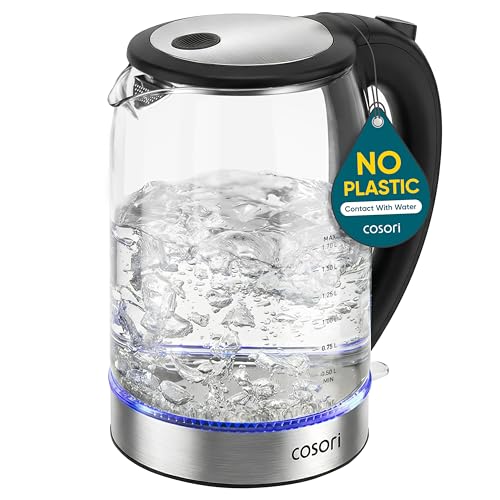
Product A · ASIN B08PP48979
COSORI Electric Glass Kettle (CGK-G173-KUS)
Last observed offer
$25.99 List Price: $27.99
Per listed package.
Offer eligibility must be confirmed on Amazon.
Checked 2026-10-19 19:11 UTC. Price and availability may change.

Product B · ASIN B0GKP9YM1G
COSORI Temperature Control Stainless Steel Kettle (CEK-S153-VUS)
Last observed offer
$89.98 List Price: $99.99
Per listed package.
Checked 2026-10-19 14:09 UTC. Price and availability may change.
Pickoryx may earn a commission from qualifying purchases through the paid Amazon links on this page, at no added cost to you.
The buying question
Is a straightforward boil routine enough, or will selectable and held water temperatures change how you make tea or coffee—and do the documented fill, pour and care steps change your routine?
The CGK-G173-KUS manual documents a fill-and-boil routine; the CEK-S153-VUS adds documented temperature presets, manual adjustments and a hold option. For refilling and cleaning, CEK documentation identifies internal level indicators and a staged lid while CGK is advertised with a wide mouth. The manuals do not distinguish ordinary pouring: both mention cooling for at least 5 minutes before pouring out first-use test water.
Quick verdict
Choose COSORI Electric Glass Kettle (CGK-G173-KUS) if
- You only need a full boil and want the simpler fill / On-Off routine described in the CGK manual.
- The CGK listing's wide-mouth access is sufficient for your refilling and cleaning needs.
Choose COSORI Temperature Control Stainless Steel Kettle (CEK-S153-VUS) if
- You want named tea/coffee presets, manual temperature steps and a documented 60-minute hold.
- An internal water-level reference and a partial-then-full lid opening are useful to your fill routine.
When the recommendation changes
- If you mostly need boiling water, the CEK temperature options may go unused; the CGK manual describes the basic boil routine.
- If your tea or coffee routine calls for a chosen lower water temperature or holding that target, the CEK documented controls may fit better. This does not establish achieved-temperature accuracy or beverage quality.
- If ordinary pouring control is decisive, these manuals do not compare normal serving flow or control. Their first-use tests and descaling instructions include discarding water or cleaning liquid; those procedures do not establish a controlled-pour advantage from the documented lid or opening features.
The differences that matter
Temperature Selection And Brewing Workflow
COSORI Electric Glass Kettle (CGK-G173-KUS)
The exact CGK manual describes filling, using the On/Off switch and automatic shutoff after boiling; it does not document selecting a target temperature or a keep-warm setting.[1]
COSORI Temperature Control Stainless Steel Kettle (CEK-S153-VUS)
The exact CEK manual documents five temperature presets, manual 5°F/C adjustments, and a Hold Temp function that maintains the selected target for 60 minutes.[3]
What this changes: The useful choice is whether you need a chosen lower temperature or hold period. These are manufacturer-documented controls, not evidence that the CEK reaches a target more accurately, boils faster or makes better-tasting drinks.[1, 3]
Filling Pouring And Cleaning Workflow
COSORI Electric Glass Kettle (CGK-G173-KUS)
The CGK manual describes opening with the lid-release button, filling between the MIN/MAX marks, closing the lid before heating, and handling the kettle carefully while it contains hot water. For the first-use test, it says to allow the boiled water to cool for at least 5 minutes, then pour it out. COSORI advertises a wide mouth and large-angle lid for access; the manual does not describe ordinary pour control or flow.[1, 2]
COSORI Temperature Control Stainless Steel Kettle (CEK-S153-VUS)
The CEK manual describes opening the lid, filling between MIN/MAX, closing it before heating, and handling the kettle carefully while it contains hot water. For its first-use test, it likewise says to allow heated water to cool for at least 5 minutes, then discard it. The manual identifies an internal water-level reference and partial/full lid positions for filling/cleaning, but does not describe ordinary pour control or flow.[3]
What this changes: The documents give a usable refill/care distinction: CEK specifies an internal level reference and staged lid, while CGK is advertised with wide-mouth access. They do not distinguish normal serving pours or support a flow/control winner. Both describe the same first-use discard constraint—cool the test water for at least 5 minutes before pouring it out—and both caution careful handling of hot water. Choose on the documented fill, temperature and care routines; if controlled pouring is decisive, verify the exact models in person or with another applicable source.[1, 2, 3]
Best for your routine
Mostly boiling water with no selected below-boil target
Best fit: COSORI Electric Glass Kettle (CGK-G173-KUS)
Based on listed features, not comparative testing.
The CGK manual documents a basic fill-and-boil control sequence; this recommendation concerns routine fit, not speed or quality.
Tea or coffee routines that use selected lower temperatures or holding
Best fit: COSORI Temperature Control Stainless Steel Kettle (CEK-S153-VUS)
Based on listed features, not comparative testing.
The CEK manual documents selectable presets, manual temperature steps and a 60-minute hold; actual accuracy and drink results were not tested.
Value and trade-offs
One or both observed offers have eligibility conditions, so no unrestricted price difference is shown.
If a live price difference remains, compare it with whether you will use CEK's temperature-selection and hold controls; the article does not endorse a specific price premium.
The available observation window is short and does not support a purchase-timing recommendation or a historical-low claim.
Limitations
- This is a feature-fit comparison based on manufacturer documentation; no hands-on testing or independent controlled test was conducted.
- The stated 5°F control steps are a product specification, not a measurement of achieved-temperature accuracy. No boil-time, taste, extraction, pouring or safety-superiority winner is established. The manuals include first-use and descaling discard steps; the at-least-5-minute cooling instruction concerns the first-use test water. They do not compare ordinary serving flow or control.
- Both manuals describe broadly similar wipe-down and periodic descaling. Neither quantifies cleanup time or comparative effort.
- The CGK manual does not identify internal water-level indicators; that documentation gap is not evidence the product lacks markings. Check the exact purchase listing if that feature matters.
- Price observations cover a short window and do not support timing advice or a historical-low claim.
Questions shoppers ask
Can the CGK-G173-KUS select a water temperature below a boil?
The exact CGK manual describes an On/Off boil routine and does not document temperature presets or manual target selection. The CEK-S153-VUS manual does document five presets and manual adjustments; this comparison does not test actual accuracy.
Which kettle is easier to clean?
The manuals do not compare cleaning time or effort. Both describe wiping the unplugged, cooled kettle and base and descaling periodically. COSORI describes wide-mouth access for CGK, while CEK documentation describes a full lid opening for cleaning.
Do the manuals describe a different way to pour from either kettle?
Not for ordinary serving. Both exact manuals show a spout and handle and warn users to handle a kettle carefully when it contains hot water. For the first-use test, both say to let the heated water cool for at least 5 minutes before pouring it out. Neither manual compares pour flow or control, so this documentation does not identify a pouring winner.
Methodology and sources
Compared the exact-model manuals and manufacturer listings for temperature controls, fill/lid details, the documented first-use pour/discard step and care instructions. Conclusions are limited to documented feature fit; no measured superiority, pour-control difference, health claim or cleaning-effort ranking is made.
Automation assisted source retrieval and fact organization. No automated temperature, boil-time, pouring, taste or owner test was conducted.
View 4 sources
- 1.COSORI Electric Glass Kettle User Manual (US)COSORI / Arovast Corporation · Official specifications · Source checked 2026-10-08 08:02 UTC
Evidence used on this page
- Official COSORI User Manuals directory download. Printed p.3 lists CGK-G173-KUS/WUS/GUS; p.7 shows controls and lid; p.8 first-use test; p.9 fill/boil and automatic shutoff; p.10 care/descaling. Coordinator directly inspected the manufacturer PDF.: For CGK-G173-KUS, the manual describes opening with the lid release, filling to the desired level without exceeding MAX, starting with the On/Off switch and automatic shutoff after boiling. It directs users to unplug/cool, wipe kettle/base with a soft damp cloth, keep the electrical socket dry and descale weekly if frequently used. For the first-use test, it also says to wait at least 5 minutes for cooling, then pour out the water; no ordinary serving flow or control comparison is provided.
- 2.Cosori Electric Tea KettleCOSORI / Arovast Corporation · Official specifications · Source checked 2026-10-08 06:32 UTC
Evidence used on this page
- Product details lines 238–265: 1.7 L capacity and wide-mouth/large-angle lid statement. The linked official US manual resolves precise model scope.: COSORI lists a 1.7 L kettle and describes a wide mouth and large-angle lid for access when cleaning. The product page does not display a model number; its linked manual establishes CGK-G173-KUS as an included model.
- 3.COSORI Temperature Control Stainless Steel Kettle User Manual (US)COSORI / Arovast Corporation · Official specifications · Source checked 2026-10-08 08:02 UTC
Evidence used on this page
- Official COSORI User Manuals directory download. Printed p.2 identifies CEK-S153-VUS; p.6 shows internal water-level indicators; p.7 lists five presets, manual 5°F/C steps and 60-minute hold; p.8 first-use test and two-level lid; p.9 use; pp.10-11 care/descaling. Coordinator directly inspected the manufacturer PDF.: The exact model manual documents five temperature presets, manual adjustment in 5°F/C increments and a 60-minute hold. It identifies internal water-level indicators and a lid that opens partially then fully; cleaning instructions call for unplugging/cooling, wiping with a soft damp cloth, keeping the underside socket dry and periodic descaling. For the first-use test, it says to let heated water cool for 5 minutes, then discard it; no ordinary serving flow or control comparison is provided.
- 4.COSORI 1.7L Stainless Steel Kettle with Precision ControlCOSORI / Arovast Corporation · Official specifications · Source checked 2026-10-08 08:02 UTC
Evidence used on this page
- Official COSORI product-page title and official User Manuals directory entry, which links this product to the CEK-S153-VUS manual.: The official COSORI site lists the 1.7L stainless-steel kettle with precision control and links its exact CEK-S153-VUS US manual from the manufacturer manual directory. The visible product page is used for product identity only; control and fill/care facts are supported by the manual, not by a separate shop domain.