
Milwaukee 48-59-1808 vs 48-59-1812: Which Charging Workflow Fits?
Choose the 48-59-1808 Rapid if its documented near-full indication fits how you return to work between charges. Choose the 48-59-1812 Standard when you normally wait for full charge and its offer makes better sense. Both make an M12 and M18 pack take turns; the selected Rapid is the 48-59-1808NNO opened/non-retail-packaging offer.
Published by Pickoryx · Published 2026-10-10
Source checked 2026-10-10 17:23 UTC
Products compared

Product A · ASIN B07VF7C18Q
Milwaukee 48-59-1808 Rapid Charger (48-59-1808NNO, opened/non-retail packaging)
Last observed offer
$55.95 List Price: $59.99
Per listed package.
Offer eligibility must be confirmed on Amazon.
Checked 2026-10-19 11:03 UTC. Price and availability may change.
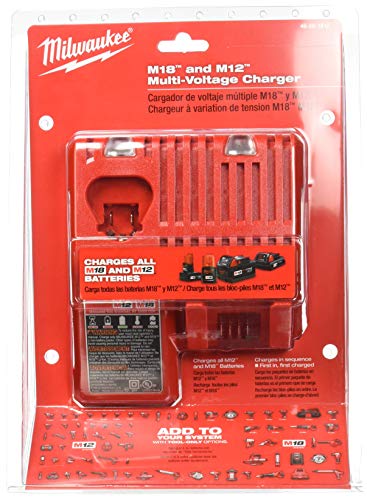
Product B · ASIN B007PDBHBG
Milwaukee 48-59-1812 M12/M18 Standard Charger
Last observed offer
$35.00 List Price: $37.99
Per listed package.
Offer eligibility must be confirmed on Amazon.
Checked 2026-10-19 11:09 UTC. Price and availability may change.
Pickoryx may earn a commission from qualifying purchases through the paid Amazon links on this page, at no added cost to you.
The buying question
Will either charge both packs together, and is the Rapid’s near-full cue useful enough to choose it?
Both retain a waiting queue; Rapid adds a documented cue for returning to work before full charge.
Quick verdict
Choose Milwaukee 48-59-1808 Rapid Charger (48-59-1808NNO, opened/non-retail packaging) if
- You want the Rapid’s 80% cue and accept the selected packaging and seller terms.
Choose Milwaukee 48-59-1812 M12/M18 Standard Charger if
- You charge ahead of use and do not need to pay extra for the Rapid workflow.
When the recommendation changes
- You require simultaneous charging.
- You stop waiting for full charges during your workday.
- The selected seller’s condition or warranty terms are unacceptable.
The differences that matter
Shared Sequential Topology
Milwaukee 48-59-1808 Rapid Charger (48-59-1808NNO, opened/non-retail packaging)
Accepts M12 and M18 packs; the second inserted pack waits for the first to finish.[1]
Milwaukee 48-59-1812 M12/M18 Standard Charger
Accepts M12 and M18 packs and charges them in sequence.[2]
What this changes: Insert the pack you need first before the other. Neither unit meets a requirement to charge an M12 and M18 simultaneously.[1, 2]
Charge Indicator Workflow
Milwaukee 48-59-1808 Rapid Charger (48-59-1808NNO, opened/non-retail packaging)
Slow-blinking green means nearly full; Milwaukee describes an 80% indication. Steady green means finished.[3, 1]
Milwaukee 48-59-1812 M12/M18 Standard Charger
Standard workflow: steady red means charging and steady green means finished. While an M18 pack charges, its own fuel-gauge lights show progress.[4]
What this changes: The Rapid’s near-full cue suits a deliberate partial-charge decision. If you normally wait for completion, the Standard’s documented workflow can suffice; do not buy Rapid merely to eliminate the shared queue.[3, 1, 4]
Best for your routine
Choosing when to leave before full charge
Best fit: Milwaukee 48-59-1808 Rapid Charger (48-59-1808NNO, opened/non-retail packaging)
Based on listed features, not comparative testing.
The documented near-full signal provides a useful checkpoint; it does not guarantee enough runtime for your next task.
Charging ahead with no mid-charge interruptions
Best fit: Milwaukee 48-59-1812 M12/M18 Standard Charger
Based on listed features, not comparative testing.
If its offer is preferable, the Standard fits a wait-until-complete routine. The compromise is foregoing the Rapid workflow, not losing M12/M18 compatibility.
Value and trade-offs
One or both observed offers have eligibility conditions, so no unrestricted price difference is shown.
If Rapid costs more, weigh its partial-charge workflow against how often you actually need it. Compare seller condition and terms before comparing prices.
Price history is insufficient for purchase timing advice.
Limitations
- The selected 48-59-1808NNO offer allows opened original packaging in imperfect condition or alternate non-retail packaging. Manufacturer evidence identifies the underlying 1808, but does not establish this seller’s box condition, contents, returns or warranty eligibility. Confirm those before purchase.
- Milwaukee’s “up to 40% faster” claim is not a fixed saving for every pack. No matched charge-time, heat, safety or battery-lifespan comparison was performed.
- Use the US models on 120V AC. Charge only the recommended Milwaukee batteries, keep vents clear and charging conditions dry, and follow the manual’s temperature limits. Do not use damaged batteries or chargers.
Questions shoppers ask
Is a blinking red light always a bad battery?
No. On both chargers, distinguish a slow-red waiting indication from fast-red temperature delay and alternating red/green fault indication. Follow the manual’s fault checks; do not bypass a protection or attempt internal repairs.
Does “multi-voltage” mean I can plug these into 230V?
No. Both US models specify 120V AC. In the Standard manual, 12/24V DC refers to a different charger, the 48-59-1810.
Methodology and sources
Compared shared queue behavior and usable charge-status cues; no hands-on speed or durability testing.
Research assistance organized the documented charging workflows and checked references.
View 4 sources
- 1.Milwaukee 48-59-1808 Rapid ChargerMilwaukee Tool · Official specifications · Source checked 2026-10-10 17:21 UTC
Evidence used on this page
- Product Overview: M12/M18 support, sequential charging, 80% indication; up-to speed claim only.
- 2.Milwaukee 48-59-1812 Multi-Voltage ChargerMilwaukee Tool · Official specifications · Source checked 2026-10-10 17:21 UTC
Evidence used on this page
- Product Overview: M12/M18 compatibility and sequential operation.
- 3.Milwaukee 48-59-1808 operator’s manualMilwaukee Tool · Official specifications · Source checked 2026-10-10 17:21 UTC
Evidence used on this page
- Pages 2–5; light indicators, specifications and charger operation: Exact model, near-full and queue indicators, temperature and fault states, US electrical input.
- 4.Milwaukee 48-59-1810 / 48-59-1812 operator’s manualMilwaukee Tool · Official specifications · Source checked 2026-10-10 17:21 UTC
Evidence used on this page
- Pages 2–5; 48-59-1812 specifications and charger operation: 1812-specific AC input; charging, full, waiting and fault indicators; M18 battery fuel gauge.