
Work Sharp Mk2 vs SHARPAL 191H: Choose the Routine and Angle
For ordinary double-beveled steel knives with a checked angle and physical fit, choose SHARPAL 191H when approximately 20° per side suits your knife and you want manual passes through stationary slots. Choose Work Sharp Mk.2 for powered-belt sharpening or its selectable 25° guide, accepting that you still control the blade, switch and belt changes.
Published by Pickoryx · Published 2026-10-09
Source checked 2026-10-09 21:46 UTC
Products compared
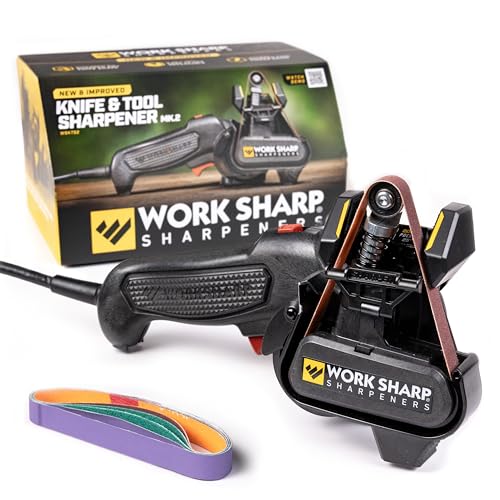
Product A · ASIN B0F41F9BWX
Work Sharp Mk.2 Electric Knife Sharpener & Replacement Belts
Last observed offer
$102.90
Per listed package.
Offer eligibility must be confirmed on Amazon.
Checked 2026-10-19 16:41 UTC. Price and availability may change.

Product B · ASIN B07WVNW73L
SHARPAL 191H Knife & Scissors Sharpener
Last observed offer
$16.99
Per listed package.
Offer eligibility must be confirmed on Amazon.
Checked 2026-10-19 07:16 UTC. Price and availability may change.
Pickoryx may earn a commission from qualifying purchases through the paid Amazon links on this page, at no added cost to you.
The buying question
Do fixed-angle manual slots fit your knives and habits, or do you need the Mk.2 powered belt and selectable knife guide?
191H offers a stationary manual routine at approximately 20° per side. Mk.2 combines powered belt movement with two guide settings, while leaving blade handling and belt changes to you.
Quick verdict
Choose Work Sharp Mk.2 Electric Knife Sharpener & Replacement Belts if
- You want the motor to drive the abrasive while you manage the knife.
- You need the documented 25° knife-guide option.
Choose SHARPAL 191H Knife & Scissors Sharpener if
- Your intended edge suits approximately 20° per side and you prefer stationary manual slots.
When the recommendation changes
- Your intended knife angle calls for the Mk.2’s 25° guide.
- You want manual sharpening and also require 25°: neither product supplies that combination.
- Your blade material, grind or shape needs a different documented routine.
The differences that matter
Sharpening Workflow
What this changes: At a suitable nominal 20° angle, the remaining choice is the routine: powered belt with blade and switch control, or manually driven passes through fixed slots. Choose the work you want to perform; neither setup makes knife handling automatic.[1, 2, 3, 4]
Guide Angle Choice
Work Sharp Mk.2 Electric Knife Sharpener & Replacement Belts
The knife guide selects 20° or 25° for sharpening and honing.[1, 2, 5, 6]
SHARPAL 191H Knife & Scissors Sharpener
The preset knife angle is approximately 20° per side.[3]
What this changes: A required 25° guide favors Mk.2 even if you otherwise prefer manual work. At 20°, angle choice alone does not settle the purchase. Mk.2’s per-side interpretation combines its guide instructions with Work Sharp’s general angle terminology; it is not literal wording from the Mk.2 manual or a measured accuracy guarantee.[1, 2, 5, 6, 3]
Best for your routine
Manual maintenance at approximately 20° per side
Best fit: SHARPAL 191H Knife & Scissors Sharpener
Based on listed features, not comparative testing.
191H fits that combination. You must still secure its base and control each knife pull.
A supported 25° guide with powered sharpening
Best fit: Work Sharp Mk.2 Electric Knife Sharpener & Replacement Belts
Based on listed features, not comparative testing.
Mk.2 provides that setting. Its motor drives the belt, not the knife; belt selection and blade control remain your tasks.
Powered sharpening when the 20° guide already suits the knife
Best fit: Work Sharp Mk.2 Electric Knife Sharpener & Replacement Belts
Based on listed features, not comparative testing.
Mk.2 can be chosen for its belt-driven routine without needing the additional angle. This is a workflow preference, not a proven edge-quality advantage.
Value and trade-offs
One or both observed offers have eligibility conditions, so no unrestricted price difference is shown.
Evaluate any current price difference against the routine and guide setting you will use. If manual 20° maintenance fits your needs, the unused 25° option is not a reason by itself to pay more.
There is not enough verified price history here to recommend buying now or waiting.
Limitations
- Neither product was tested hands-on. Sharpness, speed, ease, angle accuracy, safety, durability and abrasive life are not ranked.
- This comparison covers the US Mk.2 sharpener-and-replacement-belts bundle WSKTS2-AP-ATL and SHARPAL 191H. The extra-belt quantity is unverified. Mk.2 machine instructions do not establish other bundles’ contents or international electrical specifications.
- The main choice excludes ceramic blades, single-bevel knives and specialty grinds. Ceramic-blade support has not been established for either exact product; a ceramic honing abrasive is not evidence of that compatibility.
Questions shoppers ask
What if I want manual sharpening at 25°?
Neither product meets both requirements: 191H is fixed at approximately 20° per side, while Mk.2 offers 25° with a powered belt. Look for a different documented setup rather than assuming an angle can be selected on 191H.
Are the angle numbers comparable?
SHARPAL explicitly specifies approximately 20° per side. Work Sharp labels the Mk.2 guide 20°/25°; reading its left/right bevel instructions together with its general angle explanations supports the per-side convention. Treat those as nominal guide settings, not measurements of the finished edge.
Do serrated knives and scissors use the same routine?
No. 191H directs serrated knives to its ceramic slot only and gives scissors separate instructions; it excludes single-bevel knives. Mk.2 has separate serrated, single-bevel and scissors sections. Check the relevant full manual instead of applying the ordinary double-bevel routine.
Which handling requirements should I check before buying?
For Mk.2: Read the full power-tool warnings. Use eye protection and the specified respiratory/hearing protection; keep hair, clothing and gloves away from moving parts. Unplug before adjustments or accessory changes. The cassette must be engaged; do not run it in the parked position. The manual limits use to 30 minutes per hour. For 191H: Use a clean, dry, smooth, flat surface with the base secured, and light heel-to-tip pulls, never back-and-forth. The manual recommends gloves for this stationary sharpener and keeping it away from children. Both expose you to sharp edges. The 191H glove recommendation must not be transferred to the powered belt. These are purchase-relevant cautions, not a substitute for either complete manual.
What should I check on the US Mk.2 bundle?
Confirm WSKTS2-AP-ATL, the sharpener-and-replacement-belts package, rather than another Work Sharp model. The linked US WSKTS2 manual specifies 120 VAC, 60 Hz and requires matching the supply to the actual nameplate. No extra-belt count or international voltage equivalence is assumed here.
Methodology and sources
Separated the physical sharpening routine from the required guide angle, then checked blade exceptions and model-specific handling limits.
AI helped organize source material and draft the comparison. Pickoryx did not test either sharpener hands-on.
View 6 sources
- 1.Knife & Tool Sharpener Mk.2Work Sharp · Official specifications · Source checked 2026-10-09 21:40 UTC
Evidence used on this page
- SKU WSKTS2; Product Features; Edge Angles: Motor-driven flexible belts and selectable 20°/25° knife guide. Base machine information, not the selected extra-belt inventory.
- 2.WSKTS2 Knife & Tool Sharpener Mk.2 User’s Guide, PP0004574 Rev 1 11/20Work Sharp · Official specifications · Source checked 2026-10-09 21:03 UTC
Evidence used on this page
- Printed pages 4–7, 9–15, 18–22: Power-tool warnings, nameplate supply, belt and guide setup, controlled knife passes and separate specialty-blade sections.
- 3.191H Knife & Scissors Sharpener with Suction CupSHARPAL · Official specifications · Source checked 2026-10-09 21:40 UTC
Evidence used on this page
- Specifications; sharpening-angle and suction-surface FAQ: Fixed approximately 20° per side for double-beveled knives; carbide/ceramic abrasives and suitable suction surface.
- 4.Item No. 191H User Manual, EnglishSHARPAL · Official specifications · Source checked 2026-10-09 21:03 UTC
Evidence used on this page
- Page 1: Before Sharpening; Knife Sharpening; Scissors; Caution; Warnings: Stationary-slot routine, light heel-to-tip pulls, single-bevel knife exclusion, ceramic-slot-only serration instruction and tool-specific glove caution.
- 5.Alex Garland Explains Knife Sharpening AnglesWork Sharp · Official specifications · Source checked 2026-10-09 21:41 UTC
Evidence used on this page
- Every Angle Starts at the Center Line; If You Need the Exact Number: General manufacturer convention distinguishes per-side angles from inclusive angles and guide labels from actual blade geometry; not an exact-model accuracy test.
- 6.What is Edge Angle? How to tell What Angle your knife is sharpened to?Work Sharp · Official specifications · Source checked 2026-10-09 21:41 UTC
Evidence used on this page
- What is edge angle?: General manufacturer explanation uses per-side edge angles; interpreted alongside Mk.2 guide labels and its separate right/left bevel procedure.