
Ryzen 7 9700X or 9800X3D: Which Fits Your AM5 Build?
The 9800X3D is the stronger fit if TechSpot's tested games resemble yours; the same review also reports leads in several named applications. The 9700X's clearest fit is a build planned around its 65W default TDP rating and AMD's premium-air-cooler recommendation. Neither rating predicts your system's measured power or heat.
Published by Pickoryx · Published 2026-10-23
Source checked 2026-10-23 01:55 UTC
Products compared

Product A · ASIN B0D6NMDNNX
AMD Ryzen 7 9700X
Last observed offer
$338.98
Per listed package.
Offer eligibility must be confirmed on Amazon.
Checked 2026-10-31 11:37 UTC. Price and availability may change.
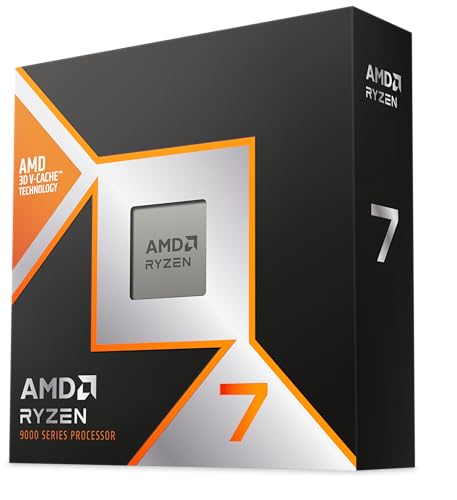
Product B · ASIN B0DKFMSMYK
AMD Ryzen 7 9800X3D
Last observed offer
$444.00 List Price: $479.00
Per listed package.
Offer eligibility must be confirmed on Amazon.
Checked 2026-10-31 13:41 UTC. Price and availability may change.
Pickoryx may earn a commission from qualifying purchases through the paid Amazon links on this page, at no added cost to you.
The buying question
Do the 9800X3D's gains in the cited gaming and application tests justify planning around its higher default TDP rating and AMD's liquid-cooler recommendation?
TechSpot's direct 2024 tests favor the 9800X3D in gaming and several named applications, while AMD lists a 120W default TDP and recommends a liquid cooler for optimal performance; the 9700X is rated at 65W and has a premium-air-cooler recommendation.
Quick verdict
Choose AMD Ryzen 7 9700X if
- Your build plan favors the 9700X's 65W default TDP rating and AMD's premium-air-cooler recommendation, and you do not need to target the specific games in TechSpot's comparison.
Choose AMD Ryzen 7 9800X3D if
- Gaming is your priority and the review's game results are relevant to your titles; plan around AMD's liquid-cooler recommendation for optimal performance.
- Your workload resembles the named applications where TechSpot measured gains for the 9800X3D, and you are comfortable with the associated cooling guidance.
When the recommendation changes
- Your own games or applications differ from the review's tested set; check independent results for those exact workloads before treating its average as predictive.
- Your cooler, case, motherboard settings, or preferred power profile differs from the review setup; AMD's default TDP and cooler guidance are planning inputs, not measured heat or a guarantee for your build.
The differences that matter
Gaming Workload Fit
AMD Ryzen 7 9700X
Baseline in the tested games.[3]
AMD Ryzen 7 9800X3D
30% higher average performance in the tested game comparison.[3]
What this changes: That favors B when the test games are relevant; it does not predict the same result in another title or build.[3]
Productivity And Creator Workload Fit
AMD Ryzen 7 9700X
Slightly behind in multi-core Cinebench; within 1% in single-core.[3]
AMD Ryzen 7 9800X3D
Led by 7% in multi-core Cinebench and 11% in Premiere Pro, and also led in Blender and Photoshop.[3]
What this changes: This review does not establish a 9700X advantage in the named apps; check results for your own software.[3]
Rated Power Profile And Cooling Planning
AMD Ryzen 7 9700X
AMD lists a 65W default TDP, says no thermal solution is included, and recommends a premium air cooler for optimal performance.[1]
AMD Ryzen 7 9800X3D
AMD lists a 120W default TDP, says no thermal solution is included, and recommends a liquid cooler for optimal performance.[2]
What this changes: Use these manufacturer ratings and recommendations to plan the cooler and power profile you want; TDP is not a measurement of wall or package power, heat, noise, or a universal cooler requirement.[1, 2]
Best for your routine
Gaming workloads represented by TechSpot's direct 2024 test set
Best fit: AMD Ryzen 7 9800X3D
The direct comparison favored the 9800X3D in the tested games; results may differ elsewhere.
A mix of creator or productivity applications
The better fit depends on your priorities
TechSpot measured gains for the 9800X3D in several named applications, while its single-core Cinebench result was nearly tied. Use results for the programs you actually run; the tested results do not establish a 9700X advantage in creator work.
Planning a build around AMD's stated default TDP and cooler guidance
The better fit depends on your priorities
The 9700X has a lower default TDP rating and an air-cooler recommendation; the 9800X3D has a higher rating and a liquid-cooler recommendation for optimal performance. Neither processor includes a thermal solution, and these statements do not establish actual heat, noise, or a required cooler for every build.
Value and trade-offs
One or both observed offers have eligibility conditions, so no unrestricted price difference is shown.
A current price premium for the 9800X3D is most relevant when its tested gaming gains or results in the applications you use matter to your build. The 9700X may better match a build planned around its lower default TDP rating and air-cooler recommendation; compare current offers only after matching seller, condition, and included parts.
Available price information is current-only; there is not enough history to make a Buy Now or Wait recommendation.
Limitations
- TechSpot's gaming and application measurements are from its November 2024 review and its stated test system, software versions, and settings; results may differ with your games, applications, GPU, memory, cooling, and BIOS.
- AMD's default TDP ratings are not measured package or wall power, temperature, noise, or proof that a particular cooler is required. AMD says neither boxed processor includes a thermal solution.
- Current offer observations do not establish long-term value or price timing. Match the exact listing, seller, condition, and package before buying.
Questions shoppers ask
Does the 9800X3D guarantee the same gaming gain in my PC?
No. TechSpot's average applies to its tested games and setup; your game, settings, graphics card, and system configuration can change the result.
Is the 9700X faster for creator applications?
The cited TechSpot tests do not show that. The 9800X3D led the 9700X in several named applications, while the single-core Cinebench result was nearly tied. Check results for the exact applications you use.
Does the 9800X3D require a liquid cooler?
AMD recommends liquid cooling for optimal performance and lists no thermal solution in the box. That is not the same as a universal requirement; choose a cooler based on AMD guidance and your build's settings and constraints.
Methodology and sources
Compared AMD's current model specifications with TechSpot's direct November 2024 tests of the 9700X and 9800X3D. Test results are attributed to TechSpot's stated hardware, software, games, and settings.
Automated tools helped locate and organize source information. Pickoryx did not test either processor hands-on.
View 3 sources
- 1.AMD Ryzen™ 7 9700XAMD · Official specifications · Source checked 2026-10-23 01:55 UTC
Evidence used on this page
- General Specifications and Product IDs: Ryzen 7 9700X, 8 cores/16 threads, AM5, 65W default TDP, no thermal solution included, premium air cooler recommended for optimal performance; boxed Product ID 100-100001404WOF.: Confirms the exact boxed model and the listed platform, default TDP and cooler recommendation. These are manufacturer specifications, not measurements of actual power, heat, or noise.
- 2.AMD Ryzen™ 7 9800X3D Desktop ProcessorAMD · Official specifications · Source checked 2026-10-23 01:55 UTC
Evidence used on this page
- General Specifications and Product IDs: Ryzen 7 9800X3D, 8 cores/16 threads, AM5, 120W default TDP, no thermal solution included, liquid cooler recommended for optimal performance; boxed Product ID 100-100001084WOF.: Confirms the exact boxed model and the listed platform, default TDP and cooler recommendation. These are manufacturer specifications, not measurements of actual power, heat, or noise.
- 3.AMD Ryzen 7 9800X3D Review: The New Gaming CPU KingTechSpot · Independent testing · Source checked 2026-10-23 01:55 UTC
Evidence used on this page
- Steven Walton, November 6, 2024; Test System Specs; Productivity Benchmarks; Head 2 Head Performance.: Exact-pair game and application tests under the review's named conditions; results do not predict every build or workload.